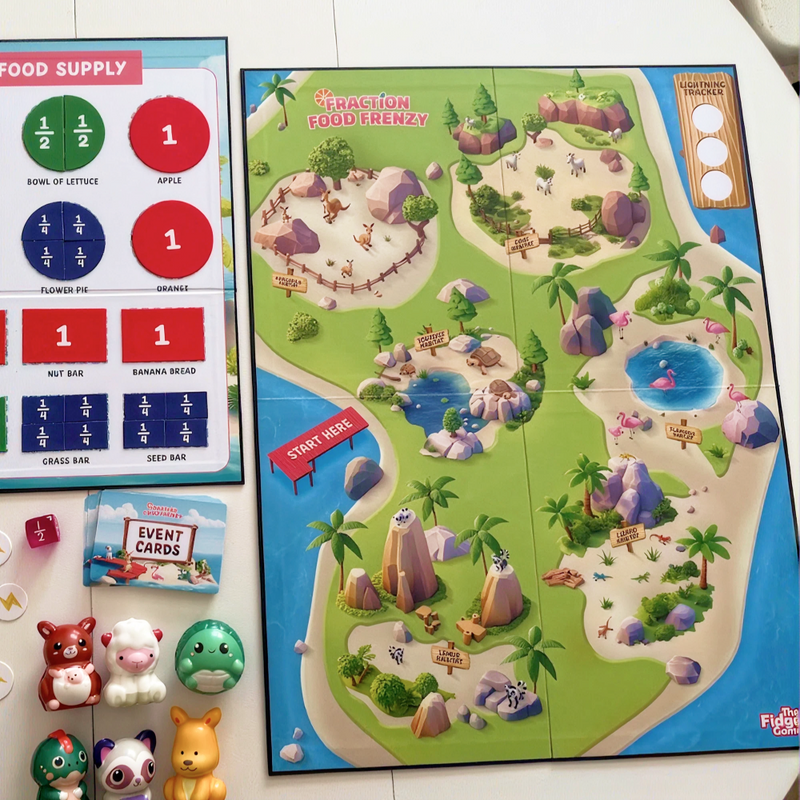
Build foundational fraction skills by identifying wholes, halves, fourths, and more
Strengthen understanding of part-to-whole relationships using visual models
Practice comparing and matching fractions with circles and rectangles
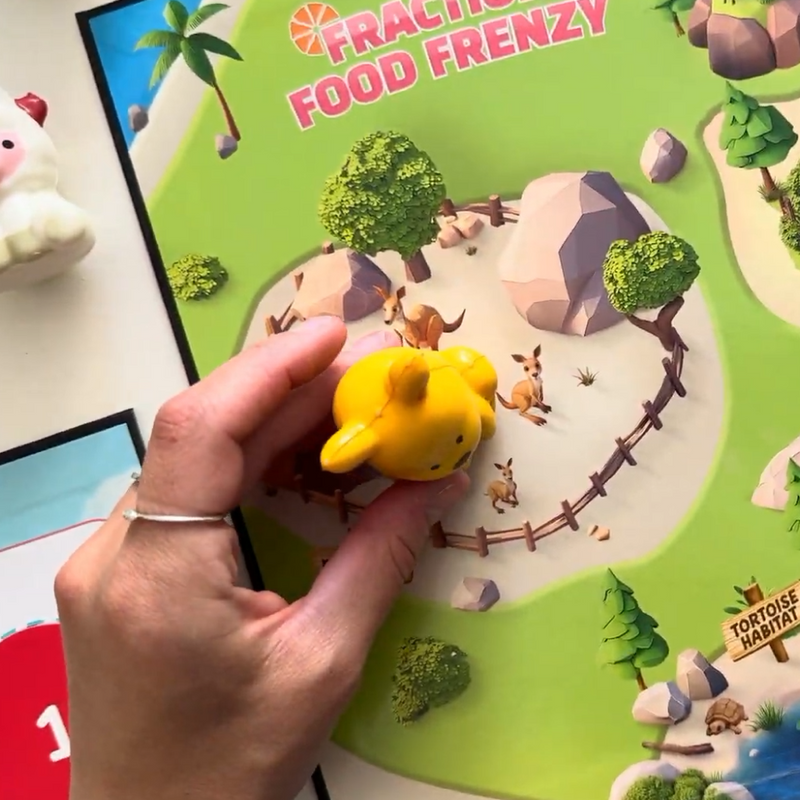
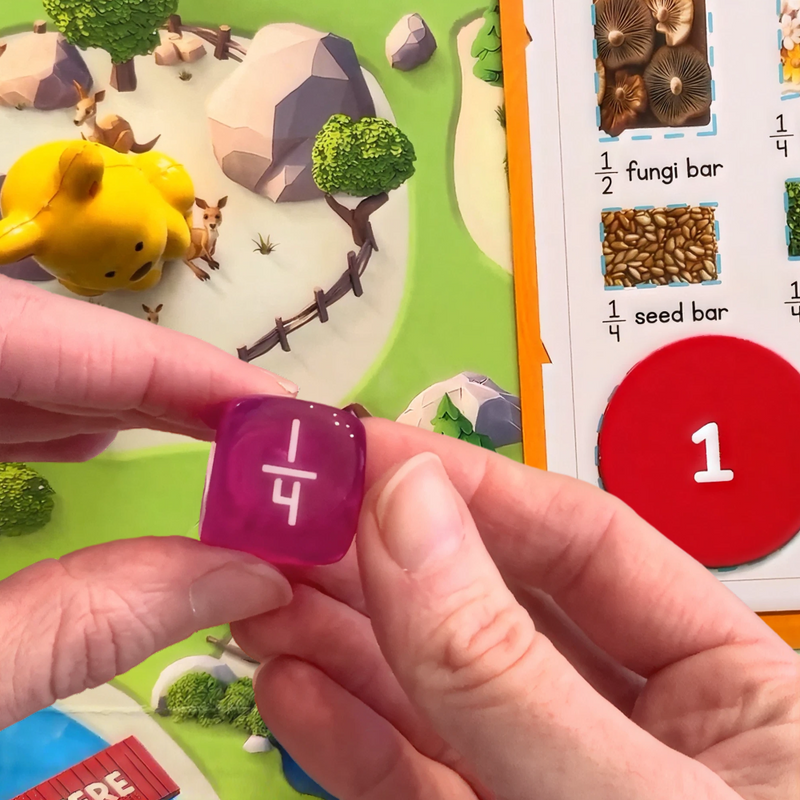
Boost real-world math confidence through hands-on fraction play
Key Features
2 to 6 players
Ages 6 to 9 (Grades 1 - 3)
Quick and Easy Play (15 - 20 min)
Educational Standards
Common Core
CCSS.Math.Content.1.G.A.3 Partition circles and rectangles into two and four equal shares, describe the shares using the words halves, fourths, and quarters, and use the phrases half of, fourth of, and quarter of. Describe the whole as two of, or four of the shares. Understand for these examples that decomposing into more equal shares creates smaller shares.
CCSS.Math.Content.2.G.A.3 Partition circles and rectangles into two, three, or four equal shares, describe the shares using the words halves, thirds, half of, a third of, etc., and describe the whole as two halves, three thirds, four fourths. Recognize that equal shares of identical wholes need not have the same shape.
CCSS.Math.Content.3.G.A.2 Partition shapes into parts with equal areas. Express the area of each part as a unit fraction of the whole. For example, partition a shape into 4 parts with equal area, and describe the area of each part as 1/4 of the area of the shape.
TEKS
2.3C: Use concrete models to count fractional parts beyond one whole using words and recognize how many parts it takes to equal one whole.
2.3B: Explain that the more fractional parts used to make a whole, the smaller the part; and the fewer the fractional parts, the larger the part.
3.3A: Represent fractions greater than zero and less than or equal to one with denominators of 2, 3, 4, 6, and 8 using concrete objects and pictorial models, including strip diagrams and number lines.
3.3C: Explain that the unit fraction 1/b represents the quantity formed by one part of a whole that has been partitioned into b equal parts where b is a non-zero whole number.
3.3E: Solve problems involving partitioning an object or a set of objects among two or more recipients using pictorial representations of fractions with denominators of 2, 3, 4, 6, and 8.
B.E.S.T.
MA.1.FR.1.1 Partition circles and rectangles into two and four equal-sized parts. Name the parts of the whole using appropriate language including halves or fourths.
MA.2.FR.1.1 Partition circles and rectangles into two, three or four equal-sized parts. Name the parts using appropriate language, and describe the whole as two halves, three thirds or four fourths.
MA.2.FR.1.2 Partition rectangles into two, three or four equal-sized parts in two different ways showing that equal-sized parts of the same whole may have different shapes.
MA.3.FR.1.1 Represent and interpret unit fractions in the form 1/n as the quantity formed by one part when a whole is partitioned into n equal parts.
Ontario
Grade 1-B1.6 use drawings to represent and solve fair-share problems that involve 2 and 4 sharers, respectively, and have remainders of 1 or 2
Grade 1- B1.7 recognize that one half and two fourths of the same whole are equal, in fair-sharing contexts
Grade 1- B1.8 use drawings to compare and order unit fractions representing the individual portions that result when a whole is shared by different numbers of sharers, up to a maximum of 10
Grade 2- B1.6 use drawings to represent, solve, and compare the results of fair-share problems that involve sharing up to 10 items among 2, 3, 4, and 6 sharers, including problems that result in whole numbers, mixed numbers, and fractional amounts
Grade 3- B1.7 represent and solve fair-share problems that focus on determining and using equivalent fractions, including problems that involve halves, fourths, and eighths; thirds and sixths; and fifths and tenths
British Columbia
Grade 3- fraction concepts
Grade 4- ordering and comparing fractions
Alberta
Grade 2- Students interpret part-whole relationships using unit fractions.
Grade 3- Students interpret fractions in relation to one whole.
Manitoba
3.N.13. Demonstrate an understanding of fractions
4.N.8. Demonstrate an understanding of fractions less than or equal to one by using concrete and pictorial representations
5.N.7. Demonstrate an understanding of fractions by using concrete and pictorial representations
New Brunswick
3.N13 Demonstrate an understanding of fractions
4.N8 Demonstrate an understanding of fractions less than or equal to one by using concrete and pictorial representations
5.N7 Demonstrate an understanding of fractions by using concrete and pictorial representations
Newfoundland & Labrador
3N13. Demonstrate an understanding of fractions
4N8. Demonstrate an understanding of fractions less than or equal to one by using concrete, pictorial and symbolic representations
5N7 Demonstrate an understanding of fractions by using concrete, pictorial and symbolic representations
Nova Scotia
3.N13: Students will be expected to demonstrate an understanding of fractions
4.N08 Students will be expected to demonstrate an understanding of fractions less than or equal to 1 by using concrete, pictorial, and symbolic representations
5.N07 Students will be expected to demonstrate an understanding of fractions by using concrete, pictorial, and symbolic representations
Prince Edward Island
3.N12 – Demonstrate an understanding of fractions
4.N8 – Demonstrate an understanding of fractions less than or equal to one by using concrete and pictorial representations
5.N7 – Demonstrate an understanding of fractions by using concrete and pictorial representations
Saskatchewan
N3.4 Demonstrate understanding of fractions concretely, pictorially, physically, and orally
N4.6 Demonstrate an understanding of fractions less than or equal to one by using concrete and pictorial representations
N5.5 Demonstrate an understanding of fractions by using concrete and pictorial representations
Our games are used in 50,000+ classroomsSpecial discounts for school districts and homeschoolers.
Get a Quote