Skip to product information
1 of 6
Educator CreatedDesigned by teachers
30-day returnshassle-free
Secure paymentsSSL encrypted
Ships in 3 daysfrom the US
Pre-K Kindergarten Grade 1 Grade 2

Rocket Race.

Rocket Race.

Regular price $34.99
Sale price $34.99 Regular price $39.99
Save $5.00 | 12% off Sold out
4.8
What's Inside The Box
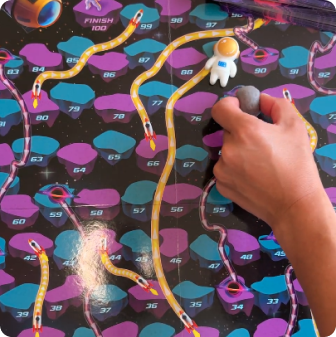
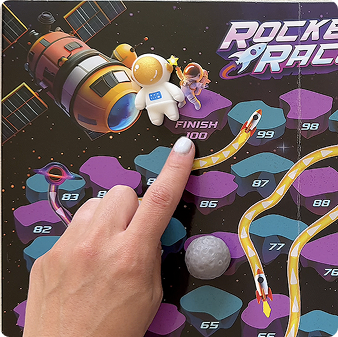
1 Game Board

1 Game Board

Counting Card Pack

Counting Card Pack

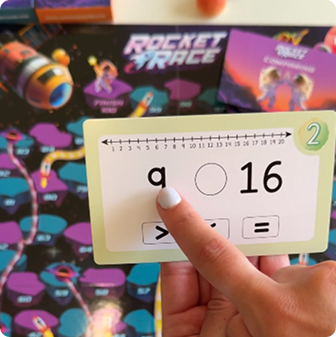
Comparing Card Pack

Comparing Card Pack

Expanded Form Card Pack

Expanded Form Card Pack

6 Squishy Game Pawns

6 Squishy Game Pawns

1 Instruction Guide

1 Instruction Guide

Expected Results After 30 Days
  • Build number sense by exploring numbers in standard, expanded, and picture forms
  • Develop a strong understanding of place value from ones to hundreds
  • Strengthen comparison skills using greater than, less than, and equal to
  • Boost math confidence
  • Encourage strategic thinking and problem-solving
Key Features
  • 2 to 6 players
  • Ages 5 to 8 (K to Grade 2)
  • Quick and Easy Play (15 min Play)
Educational Standards
Common Core
  • CCSS.Math.Content.K.CC.B.4 Understand the relationship between numbers and quantities; connect counting to cardinality.
  • CCSS.Math.Content.K.CC.C.6 Identify whether the number of objects in one group is greater than, less than, or equal to the number of objects in another group.
  • CCSS.Math.Content.K.CC.C.7 Compare two numbers between 1 and 10 presented as written numerals.
  • CCSS.Math.Content.K.NBT.A.1 Compose and decompose numbers from 11 to 19 into ten ones and some further ones, e.g., by using objects or drawings, and record each composition or decomposition by a drawing or equation (such as 18 = 10 + 8); understand that these numbers are composed of ten ones and one, two, three, four, five, six, seven, eight, or nine ones.
  • CCSS.Math.Content.1.NBT.B.2 Understand that the two digits of a two-digit number represent amounts of tens and ones.
  • CCSS.Math.Content.1.NBT.B.3 Compare two two-digit numbers based on meanings of the tens and ones digits, recording the results of comparisons with the symbols >, =, and <.
  • CCSS.Math.Content.2.NBT.A.1 Understand that the three digits of a three-digit number represent amounts of hundreds, tens, and ones; e.g., 706 equals 7 hundreds, 0 tens, and 6 ones.
  • CCSS.Math.Content.2.NBT.A.4 Compare two three-digit numbers based on meanings of the hundreds, tens, and ones digits, using >, =, and < symbols to record the results of comparisons.
  • CCSS.Math.Content.2.NBT.A.3 Read and write numbers to 1000 using base-ten numerals, number names, and expanded form.
TEKS
  • K.2C: Count a set of objects up to at least 20 and demonstrate that the last number said tells the number of objects in the set regardless of their arrangement or order.
  • K.2G: Compare sets of objects up to at least 20 in each set using comparative language.
  • K.2H: Use comparative language to describe two numbers up to 20 presented as written numerals.
  • 1.2B: Use concrete and pictorial models to compose and decompose numbers up to 120 in more than one way as so many hundreds, so many tens, and so many ones.
  • 1.2C: Use objects, pictures, and expanded and standard forms to represent numbers up to 120.
  • 1.2E: Use place value to compare whole numbers up to 120 using comparative language.
  • 1.2G: Represent the comparison of two numbers to 100 using the symbols >, <, or =.
  • 2.2A: Use concrete and pictorial models to compose and decompose numbers up to 1,200 in more than one way as a sum of so many thousands, hundreds, tens, and ones.
  • 2.2B: Use standard, word, and expanded forms to represent numbers up to 1,200.
  • 2.2D: Use place value to compare and order whole numbers up to 1,200 using comparative language, numbers, and symbols (>, <, or =).
B.E.S.T.
  • MA.K.NSO.1.1 Given a group of up to 20 objects, count the number of objects in that group and represent the number of objects with a written numeral.
  • MA.K.NSO.1.4 Compare the number of objects from 0 to 20 in two groups using the terms less than, equal to or greater than.
  • MA.K.NSO.2.3 Locate, order and compare numbers from 0 to 20 using the number line and terms less than, equal to or greater than.
  • MA.K.NSO.2.2 Represent whole numbers from 10 to 20, using a unit of ten and a group of ones, with objects, drawings and expressions or equations.
  • MA.1.NSO.1.2 Read numbers from 0 to 100 written in standard form, expanded form and word form. Write numbers from 0 to 100 using standard form and expanded form.
  • MA.1.NSO.1.3 Compose and decompose two-digit numbers in multiple ways using tens and ones. Demonstrate each composition or decomposition with objects, drawings and expressions or equations.
  • MA.1.NSO.1.4 Plot, order and compare whole numbers up to 100.
  • MA.2.NSO.1.2 Compose and decompose three-digit numbers in multiple ways using hundreds, tens and ones. Demonstrate each composition or decomposition with objects, drawings and expressions or equations.
  • MA.2.NSO.1.3 Plot, order and compare whole numbers up to 1,000.
Our games are used in 50,000+ classroomsSpecial discounts for school districts and homeschoolers. Get a Quote
View full details

Families Who Have Already Made Math Fun

4.8
Skills Built

What skills does Rocket Race. build?

Numbers
Counting and recognizing numbers
Place Value
Tens, ones & understanding bigger numbers
30-Day Money Back Guarantee
How to Play

How to play Rocket Race.

Watch How Rocket Race. Works

* Results based on internal study with regular users. Individual results may vary.

You ask, we answer!

Are there different levels of difficulty for different ages or skill levels?

Yes! Rocket Race includes three differentiated card packs, each targeting specific skills within number sense and place value. Within each card pack, there are two skill levels:

  • Green-outlined cards = Beginner level
  • Blue-outlined cards = Advanced level

This allows students to play at their own level, even during the same game, making it perfect for mixed-ability groups.

How is this different from just using a worksheet or math app?

Rocket Race offers gamified and multisensory learning, which research shows is far more engaging and effective than traditional worksheets or apps. Students are actively involved as they roll dice, move pieces, solve problems, and celebrate wins. This approach makes math both memorable and meaningful. It also helps build fluency through repetition in a fun and motivating way.

Can my child play this independently or does it require adult supervision?

Yes, children can play this independently. We recommend having an adult introduce the rules at first, but once they understand how to play, students can enjoy the game on their own. Solo play is also possible, as students can challenge themselves to reach space 100 to win the game.

My child struggles with math. Is this game still a good fit?

Yes. Rocket Race is ideal for students who need extra support in math. It focuses on essential foundational skills such as:

  • Counting and one-to-one correspondence
  • Understanding place value and base ten
  • Comparing numbers and quantities
  • Using symbols to compare values
  • Writing numbers in expanded form based on visual models

The game breaks complex concepts into fun, manageable pieces and helps students build confidence through hands-on practice.

Is this game too easy for a 2nd grader who’s already strong in math?


No. Rocket Race supports fluency and critical thinking. Even students who are strong in math benefit from the repetition and strategic problem solving that the game provides.

Are the game pieces safe and non-toxic?


Yes. All game components are made from food-grade, non-toxic materials that are safe for children.

Can this be used in math centers or small groups?

Yes. Rocket Race is perfect for math centers or small group instruction. It is no-prep and ready to play, making it easy for teachers to implement. The built-in differentiation allows students to work at their own level during the same session.

Can I use this with my intervention group or special education students?

Yes. Rocket Race works well in intervention and special education settings. It includes visual supports, multiple-choice answers in a field of three, and scaffolded learning that aligns with best practices in special education. The hands-on format makes it accessible and engaging for a wide range of learners.

Can I wash the squishies?

Yes. The squishies included in Rocket Race can be gently cleaned using warm water and mild soap. Be sure to let them air dry completely before using again.

What is the return policy?

We offer a 30-day return policy for eligible items.