


Le Monde de Squishy.
Le Monde de Squishy.
Couldn't load pickup availability
Skill Covered After 30 Days
- Builds recognition of high-frequency French words
- Expands vocabulary through meaningful picture-word connections
- Strengthens letter-sound relationships to support decoding
- Develops phonemic awareness and sound identification skills
- Helps learners read new French words with confidence and independence
Key Features
- 2 to 6 players
- Ages 5 to 8 (Grades K-2)
- Quick and easy play (15 minutes)
Educational Standards
Ontario
Kindergarten:
Use reading behaviours to make sense of familiar and unfamiliar texts in print:
-Use pictures; Use knowledge of a few high‑frequency words
-Use pictures; use knowledge of sound‑symbol relationships
Grade 1:
C1.4: Identify and use a few strategies to expand vocabulary through reading (e.g., identify cognates [mots apparentés] and familiar words; recognize smaller words within larger words).
C1.3: Read French texts containing familiar words, using a variety of cues (e.g., connect letter combinations to specific sounds in high-frequency words)
Grade 2:
C1.3 read French texts containing familiar words, using a variety of cues (e.g., use knowledge of consonant blends and phonemes to read new words; find words with a specific phoneme)
BC
Kindergarten:
-Phonemic Awareness: letter sounds
-Spelling Conventions: letters of the alphabet
Grade 1:
-Phonemic Awareness: phonemes
-Language Elements: simple affirmative sentences
-Read simple sentences, decoding the words, pronouncing them correctly and following punctuation conventions.
Grade 2:
-Visualize information when reading in order to facilitate comprehension
-Spelling conventions (complex sounds)
Alberta
Kindergarten:
Phonological awareness: Children recognize sounds that are heard.
Phonics: Children recognize the connections between oral and written language.
Grade 1:
Vocabulary: Students use new words and make connections between oral and written language to understand and express themselves.
Phonological awareness: Students manipulate words in sentences, as well as manipulate phonemes and syllables in spoken words.
Phonics: Students explore letter-sound (grapheme-phoneme) correspondences in decoding and practice.
Grade 2:
Vocabulary: Students integrate new words into their vocabulary and learn spelling patterns to understand.
Phonological awareness: Students modify words and sentences orally by manipulating phonemes, syllables, and words.
Phonics: Students apply their knowledge of grapheme-phoneme correspondences to decode, read, and write short texts.
Manitoba
Kindergarten:
É-AC3 demonstrates an awareness of the characteristics of French sounds
É-GV7 Uses visual supports to help understand
Grade 1:
É-DV1 demonstrates understanding of short and simple texts in different ways such as words or sentences.
É-DV2 recognizes specific elements of a text:
• sound games and repetition
• important sound or visual cues
É-AC3 demonstrates an awareness of the characteristics of French sounds
Grade 2:
AP-AC1 uses visual cues, sentence segmentation, syllables, as well as cues related to word form, word order, graphophonetics (letter–sound relationships), and meaning.
New Brunswick
Kindergarten:
-Communicating simple ideas on familiar subjects in French
-Use meaning cues (picture cues) to predict
-Retrieving very basic information
Grade 1:
Phonological Awareness: Recognize, hear, and manipulate the syllables and sounds of the French language.
Phonics: Establish connections between spoken sounds (phonemes) and written sounds (graphemes) to read words in a text.
Vocabulary: Use knowledge of the vocabulary acquired to facilitate your reading.
Grade 2:
Phonological Awareness: Recognize, hear and manipulate the syllables and sounds of the French language.
Phonics: Establish connections between oral sounds (phonemes) and written sounds (graphemes) to read words in a text.
Newfoundland & Labrador
Kindergarten:
-Recognize the first and last sounds of a word
-Name the letters and the sounds of the letters of the alphabet
-Start using the sounds at the beginning of words to decipher unknown words -Recognize frequent words in a text
Grade 1:
-Recognize the first sound, the middle sound, and the final sound of a word
-Recognize that words are made of letters and sounds and that sentences are made of words -Read the sounds made by the letters of the alphabet and recognize the sounds made by most letter groups -Segment a word from the text into syllables and group sounds to make a word
Grade 2:
-Recognize the sounds made by most letter groups
-Use sounds to solve unknown words and groups of known sounds to solve unknown words.
Nova Scotia
Kindergarten:
-Uses words that have already been modeled and used orally to make connections between spoken and written language
-Uses their developing spelling knowledge to decode and blend sounds, enabling them to read simple words
Grade 1:
-Uses known and practiced sounds to pronounce phonemes orally in the context of words with two or three syllables
-Uses their knowledge of phonetics and phoneme blending to read familiar words and those newly modeled and used orally, both in isolation and in various textual contexts
-Uses their developing spelling knowledge to decode a word with increasing accuracy while reading
Grade 2:
-Reads, spells, and writes the most common consonant and vowel grapheme–phoneme correspondences.
-Uses phonics knowledge, including phoneme blending, to read words from their existing vocabulary as well as newly modeled words that have already been used orally.
-Uses phonemic segmentation to spell phonetically regular one- and multi-syllable words that are part of their existing vocabulary, as well as newly modeled words used orally.
Prince Edward Island
Kindergarten:
RAS ML.0 Develop phonological awareness by recognizing and manipulating words, syllables, and phonemes.
RAS ML.2 Apply knowledge of grapheme–phoneme correspondence to decode
Grade 1:
RAS 1L.2 Use a strategic system of actions to achieve a literal understanding of simple texts.
Grade 2:
RAG 2L.0 Apply knowledge of grapheme–phoneme correspondence to decode
Saskatchewan
Kindergarten:
1.GL.1 Use visual and auditory clues with prompting for the interpretation of a listening or viewing experience.
^Specific expectation: 1.CS.1(h) Matches spoken words for colours, food, pets, transportation, body parts, or clothing by pointing to an icon, illustration or photo.
Grade 1:
1.CS.1 Demonstrate an understanding of a number of oral key words and familiar phrases
1.LK.1 Demonstrate acquisition of French language concepts, related to themes: knowledge of key words or phrases.
Grade 2:
1.CS.1 Demonstrate an understanding of a number of oral key words
CS.4 Reproduce, with prompting and support, a single key word in print.


What skills does Le Monde de Squishy. build?
How to play Le Monde de Squishy.
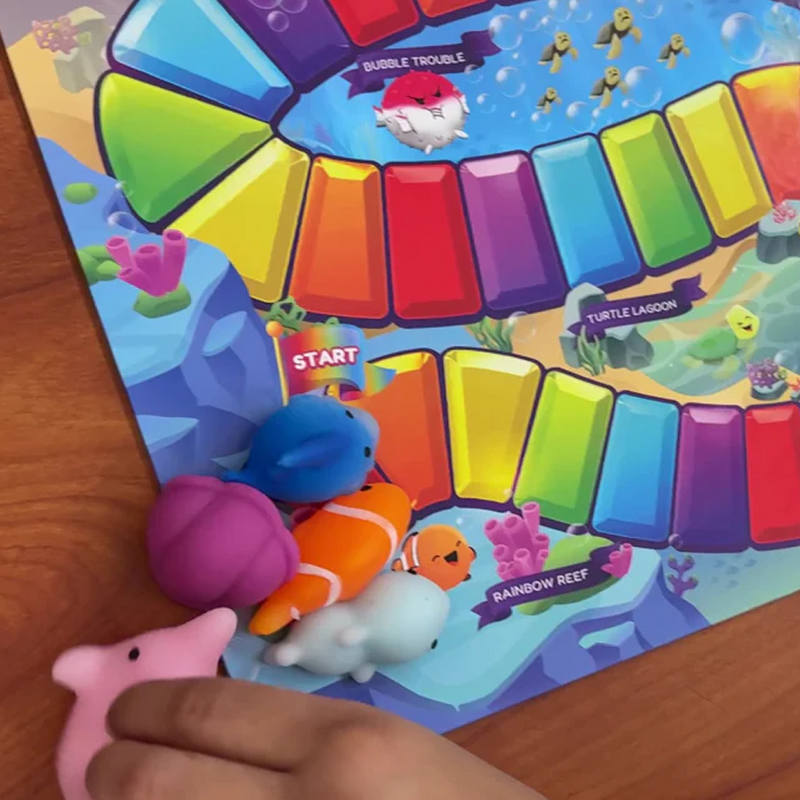
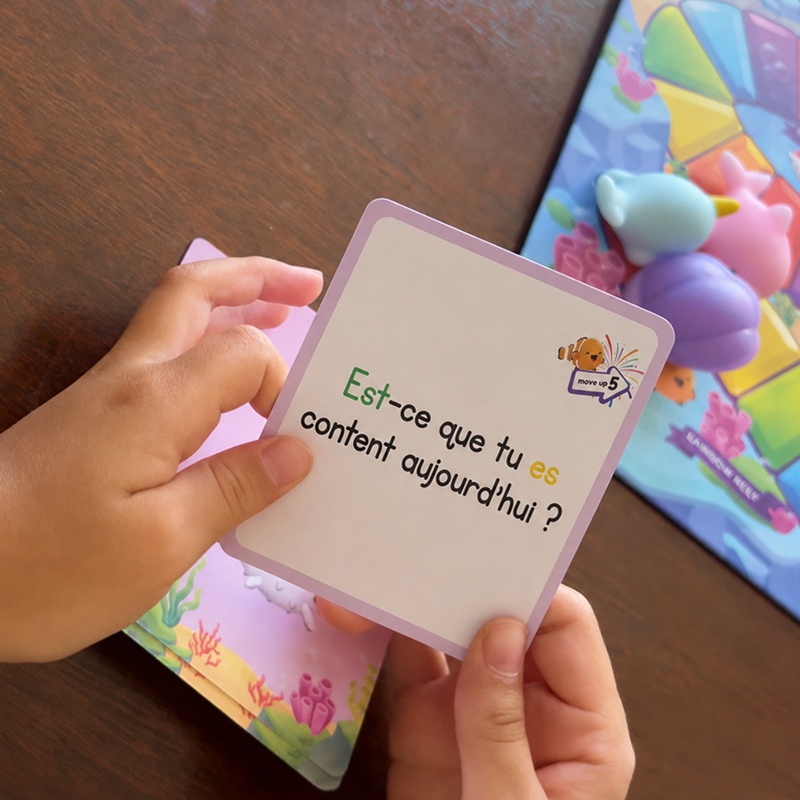
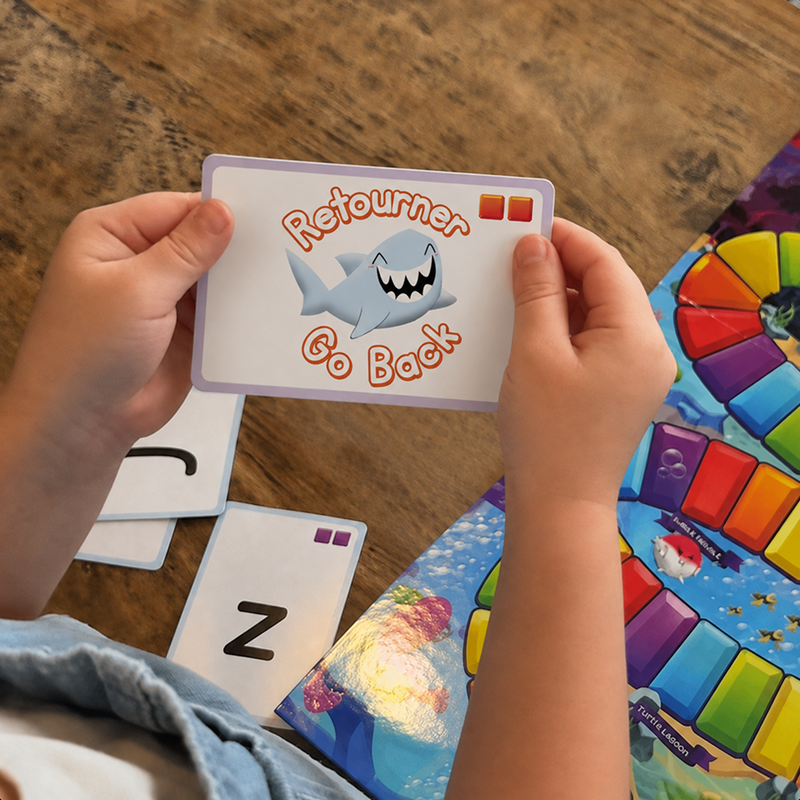

Watch How Le Monde de Squishy. Works


You ask, we answer!
We offer a 30-day return policy for eligible items.