


Derivational Suffixes Card Pack
Educator Createdorders over $50.00
30-day returnshassle-free
Secure paymentsSSL encrypted
Ships in 3 daysfrom CA
Squishyland 3-5 Expansion Card Packs.
Squishyland 3-5 Expansion Card Packs.
Regular price
$14.99
Sale price
$14.99
Regular price
$19.99
Unit price
per
What's Inside The Box
Skills Covered in 30 Days
Demonstrate foundational literacy skills through mastery of:
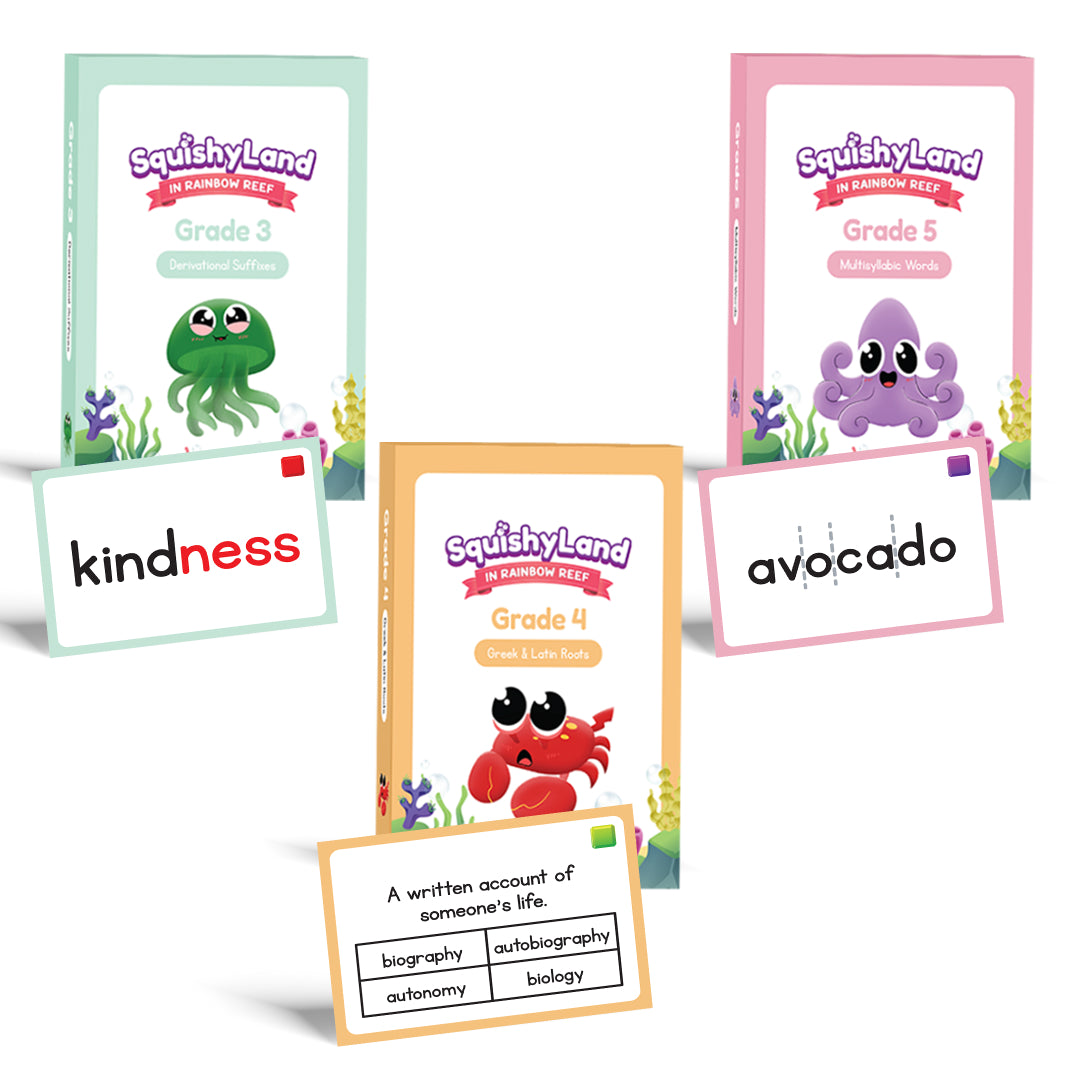
- Derivational suffixes (Grade 3)
- Greek and Latin roots (Grade 4)
- Multisyllabic word reading (Grade 5)
- Enhance phonemic awareness and decoding abilities
- Strengthen vocabulary, spelling, and overall reading fluency
- Build confidence in tackling complex words across subjects
Key Features
*These are extra card packs for the original game*
- 2 to 4 players.
- Ages 8 to 11 (Grade 3 to Grade 5)
- Quick and Easy Play (15 min Play)
Educational Standards
Common Core
- CCSS.ELA-LITERACY.RF.3.3.AIdentify and know the meaning of the most common prefixes and derivational suffixes.
- CCSS.ELA-LITERACY.RF.4.3 Know and apply grade-level phonics and word analysis skills in decoding words.
- CCSS.ELA-LITERACY.RF.5.3 Know and apply grade-level phonics and word analysis skills in decoding words.
TEKS
- ELA.3.3.C identify the meaning of and use words with affixes such as im- (into), non-, dis-, in- (not, non), pre-, -ness, -y, and -ful
- ELA.4.3.C determine the meaning of and use words with affixes such as mis-, sub-, -ment, and -ity/ty and roots such as auto, graph, and meter
- ELA.5.2A.ii: decoding multisyllabic words with closed syllables; open syllables; VCe syllable; vowel teams, including digraphs and diphthongs; r-controlled syllables; and final stable syllables
B.E.S.T.
- ELA.3.F.1.3.b Decode words with common derivational suffixes and describe how they turn words into different parts of speech. (e.g., -ful, -less, -est).
- ELA.4.F.1.3.a Apply knowledge of all letter-sound correspondences, syllabication patterns, and morphology to read and write unfamiliar single-syllable and multisyllabic words in and out of context.
- ELA.5.F.1.3.a Apply knowledge of all letter-sound correspondences, syllabication patterns, and morphology to read and write unfamiliar single-syllable and multisyllabic words in and out of context.
Ontario
- Grade 3:
- B2.1 use consolidated phonics knowledge, including phonemic blending to read words and set for variability to correct approximations, and phonemic segmentation to spell phonetically regular monosyllabic and multisyllabic words, in isolation and various text contexts
- B2.3 use developing knowledge of the meanings of words and morphemes (i.e., bases, prefixes, and suffixes) to read and spell words
- B2.4 demonstrate an understanding of a variety of words, acquire and use explicitly taught vocabulary in various contexts, including other subject areas, and use morphological knowledge to analyze and understand new words in context
- Grade 4
- B2.1 use knowledge of the meanings of words and morphemes (i.e., bases, prefixes, and suffixes) to read and spell words
- B2.2 demonstrate an understanding of a variety of words, acquire and use explicitly taught vocabulary in various contexts, including other subject areas, and use morphological knowledge to analyze and understand new words in context
- Grade 5
- B2.1 use generalized knowledge of the meanings of words and morphemes (i.e., bases, prefixes, and suffixes) to read and spell words with accuracy and automaticity
- B2.2 demonstrate an understanding of a variety of words, acquire and use explicitly taught vocabulary in various contexts, including other subject areas, and use generalized morphological knowledge to analyze and understand new words in context
BC
- Grade 3- Strategies and processes: reading strategies
- Grade 4- Strategies and processes: reading strategies
- Grade 5- Strategies and processes: reading strategies
Alberta
- Grade 3
- Students analyze new words and morphemes to enhance vocabulary.
- Students investigate how phonics connects to word formation and supports the processes of reading and writing.
- Grade 4
- Students expand vocabulary and analyze morphemes to communicate in multiple contexts.
- Grade 5
- Students analyze how knowledge of vocabulary supports meaning and use of language.
Manitoba
- Grades 3 - 5: Recognize, apply, and adapt rules and conventions (e.g., form, genre, grammar, register, punctuation, elements of design, spelling, legibility).
- Grades 3 - 5: Identify, analyze, and apply understandings of whole-part-whole relationships (e.g., function and relationship of parts within a whole design, cueing systems, fluency, word study).
New Brunswick
- Grade 3
- Differentiate sounds in spoken language.
- Apply letter-sound knowledge and decoding strategies when reading unfamiliar connected text.
- Use a range of vocabulary when communicating.
- Grade 4
- Apply letter-sound knowledge and decoding strategies when reading unfamiliar connected text.
- Use a range of vocabulary when communicating.
- Grade 5
- Apply letter-sound knowledge and decoding strategies when reading unfamiliar connected text.
- Use a range of vocabulary when communicating.
Newfoundland & Labrador
- Grade 3- GCO 4: Students will be expected to select, read, and view with understanding a range of literature, information, media, and visual texts. 18.0 use strategies to make sense of texts
- Grade 4- GCO 4: Students will be expected to select, read, and view with understanding a range of literature, information, media and visual texts. 4.4 use strategies to make sense of texts
- Grade 5- GCO 4: Students will be expected to select, read and view with understanding a range of literature, information, media and visual texts. 4.1 use cueing systems to construct meaning ; 4.3 develop proficient reading and viewing skills.
Nova Scotia
- Grade 3- Learners will demonstrate a variety of ways to comprehend and select from a range of culturally diverse texts.
- Grade 4- Learners will demonstrate a variety of ways to select and comprehend from a range of culturally diverse print and digital texts.
- Grade 5- Learners will demonstrate a variety of ways to select and comprehend from a range of culturally diverse print and digital texts.
Prince Edward Island
- Grade 3- Students will be expected to select, read, and view with understanding a range of literature, information, media, and visual texts.
- Grade 4- Students will be expected to select, read, and view with understanding a range of literature, information, media, and visual texts.
- Grade 5- Students will be expected to select, read, and view with understanding a range of literature, information, media, and visual texts.
Saskatchewan
- Grade 3- CR3.4 Read fluently and demonstrate comprehension of grade-appropriate fiction, script, poetry, and non-fiction from various cultures (including First Nations and Métis) and countries (including Canada) and explain reactions and connections to texts read.
- Grade 4- CR4.4 Read for various purposes and demonstrate comprehension of grade-appropriate fiction (including stories and novels), scripts, poetry, and non-fiction (including magazines, reports, instructions, and procedures) from various cultures including First Nations and Métis and countries (including Canada).
- Grade 5- CR5.4 Read and demonstrate comprehension of a range of contemporary and classical grade-appropriate fiction, script, poetry, and non-fiction (including magazines, reports, instructions, and procedures) from various cultures including First Nations, Métis, and Inuit and countries (including Canada).
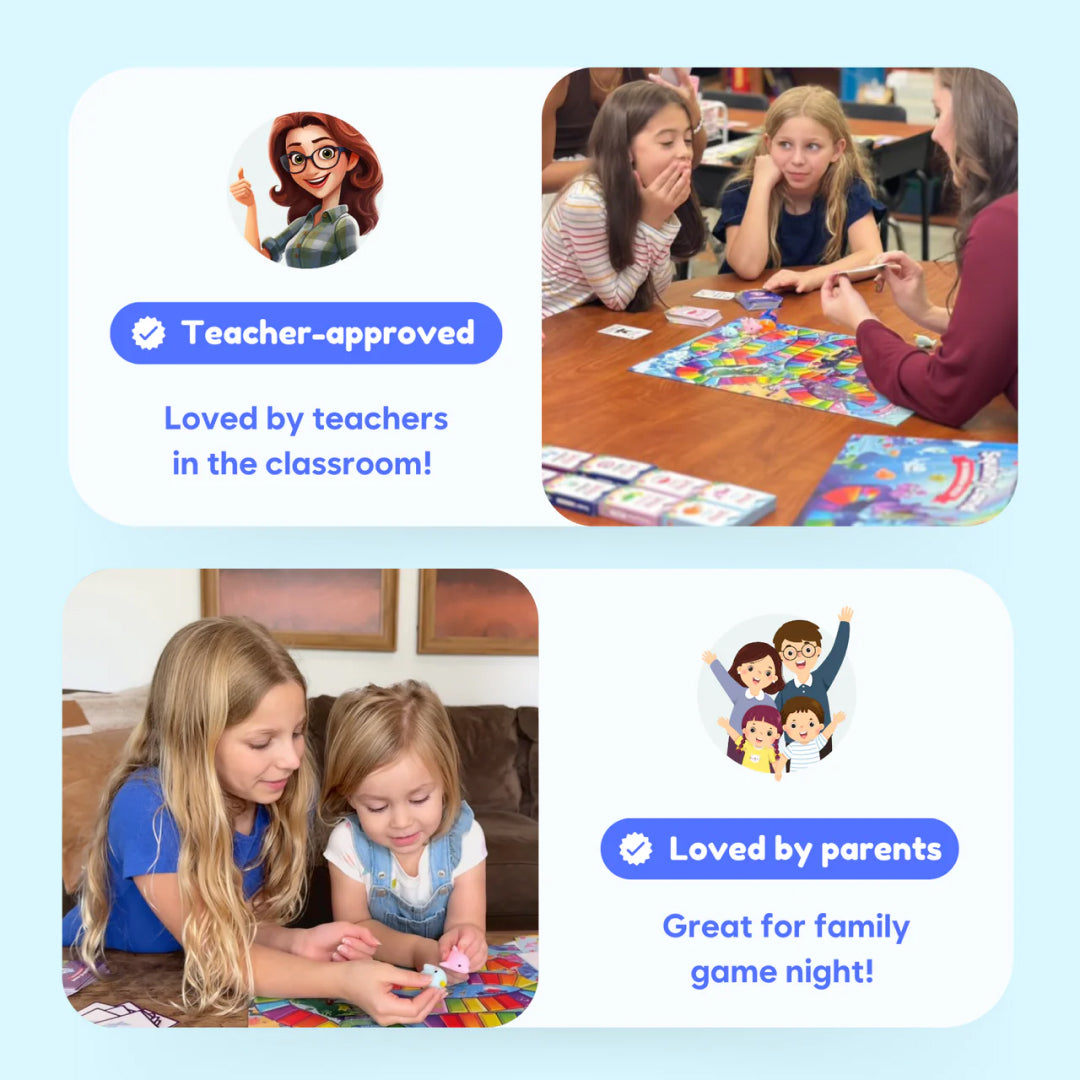
Our games are used in 50,000+ classroomsSpecial discounts for school districts and homeschoolers.
Get a Quote


Families Who Have Already Learned to Read
4.86
Skills Built
What skills does Squishyland 3-5 Expansion Card Packs. build?
Comprehension
Understanding what you read
Vocabulary
Learning and using new words
30-Day Money Back Guarantee
How to Play
How to play Squishyland 3-5 Expansion Card Packs.

1
Choose a character & card pack.

2
Draw a card & complete the challenge.

3
Move your squishy as directed.

4
Reach Crystal Castle first to win!
Watch How Squishyland 3-5 Expansion Card Packs. Works


* Results based on internal study with regular users. Individual results may vary.
You ask, we answer!
What is the return policy?
We offer a 30-day return policy for eligible items.